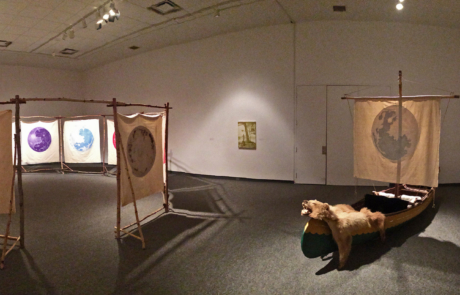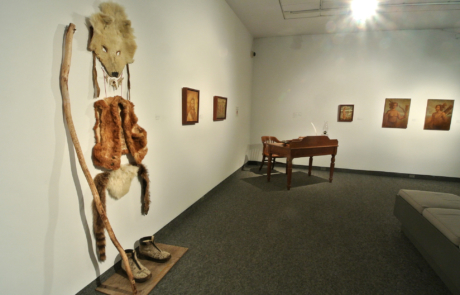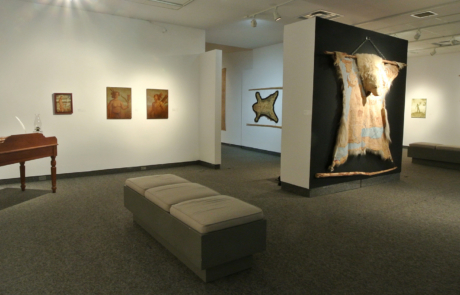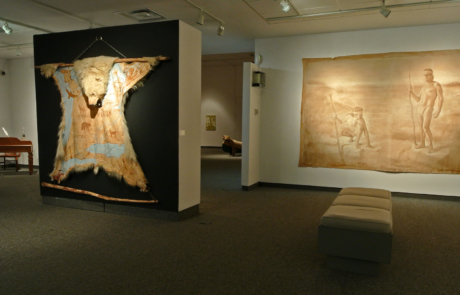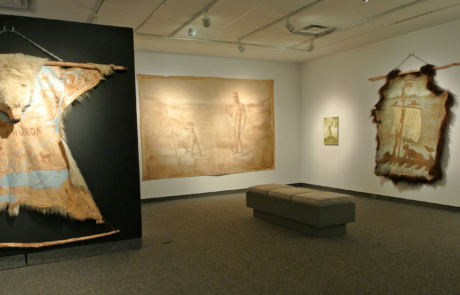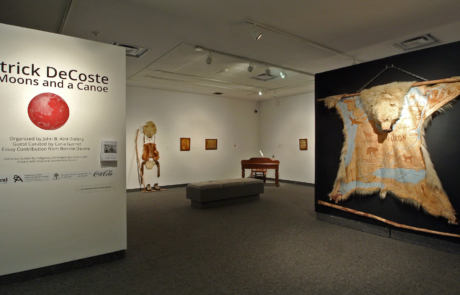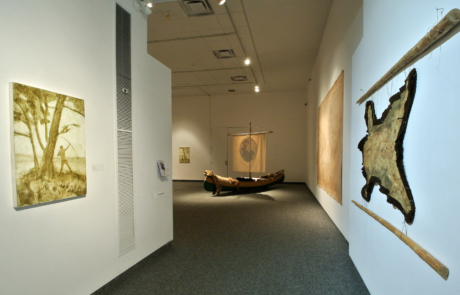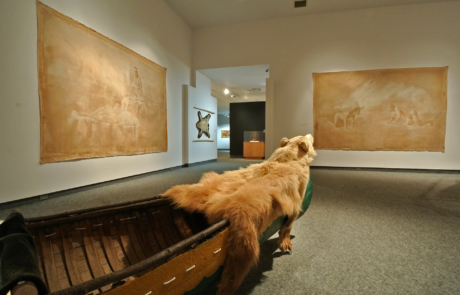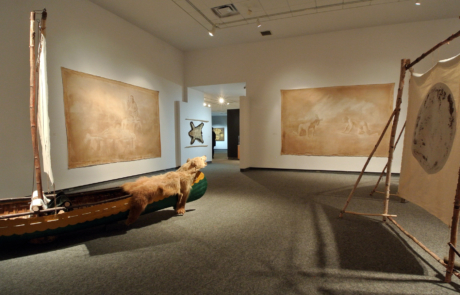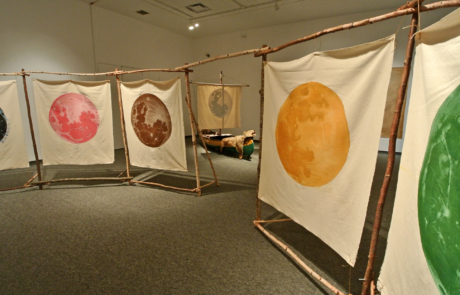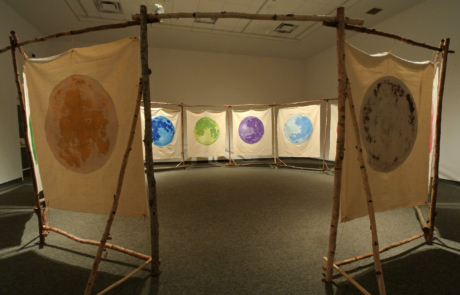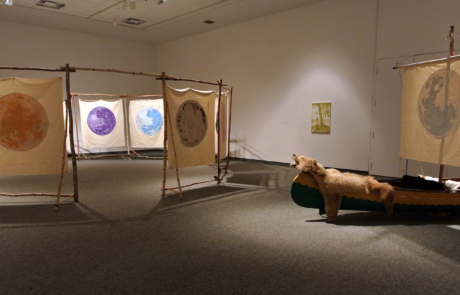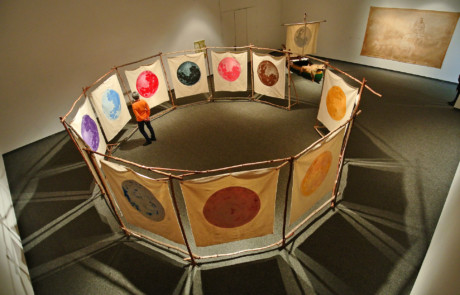

Patrick DeCoste is an award-winning Toronto-based visual artist who studied fine arts at Mount Allison University. He has exhibited extensively in Toronto, as well as New York City and beyond. The Globe and Mail calls him ‘a young old master,’ and Los Angeles writer Chris Kraus in C-Magazine describes his painting as ‘heroic and musty, strange and disturbing. He was awarded a Chalmers Arts Fellowship in 2011.
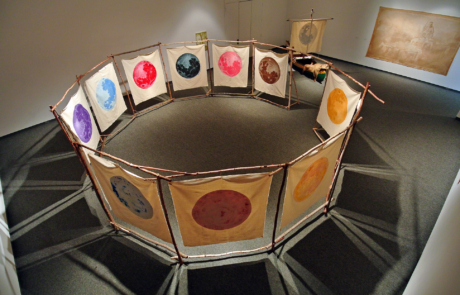
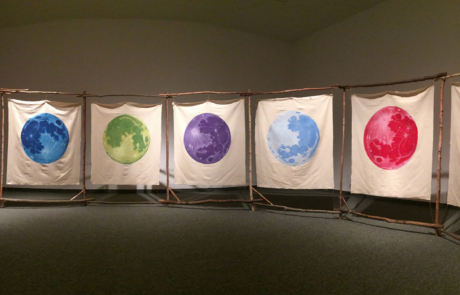
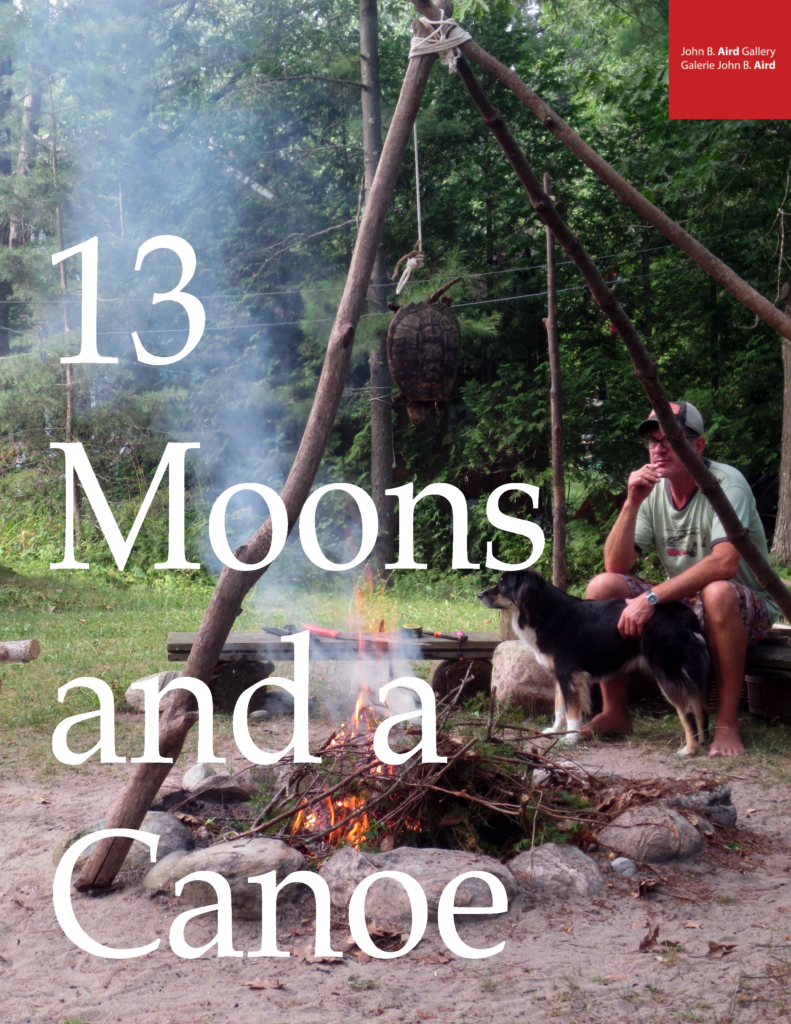
Through his art, he explores Indigenous histories and his Nova Scotia Métis roots. In 2014, he received the President’s Award for Outstanding Achievement in Graduate Studies from OCADU, where he completed an Interdisciplinary MFA. His recent exhibitions include solo exhibitions at Galerie Youn, Montreal 2014; Station Gallery, Whitby, 2015. This past yea,r DeCoste was awarded grants from The Canada Council for the Arts for the production of new works, from The Ontario Arts Council’s Aboriginal Artists in Schools program and from the Toronto Arts Council for his 13 Moons and A Canoe exhibit. When not in the city, Patrick spends time at his studio on Georgian Bay, near Lafontaine, canoeing with his dog Luca, and making art in the forest.
Thanks to community supporter Grey Roots Museum & Archives for all loans included inthe exhibition. Patrick DeCoste would like to acknowledge his appreciation and thanks to the Tom Thomson Art Gallery staff, Director/Curator Carla Garnet of John B. Aird Gallery in Toronto, Ontario and writer Bonnie Devine. Thanks to the Ontario
Arts Council and the Toronto Arts Council for funding support of this exhibition.
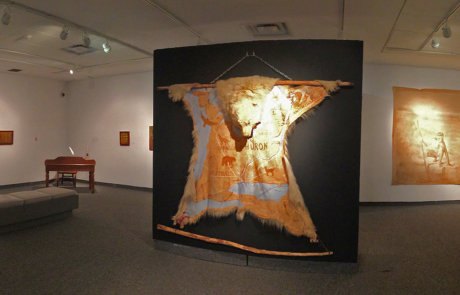
Métis Mapping by Patrick DeCoste, 2018
During my childhood, my family never spoke of being Métis. When my father died, my mother showed me our family tree and pointed to Marie-Therez, a Mi’kmaw woman, who married Claude Petitpas, a French settler in Port Royal, Nova Scotia, in the 1600s. Their Métis children, along with other Métis families, lived harmoniously with the Acadians (French) and Mi’kmaq for many generations. When the British arrived in the 1700s they put a bounty on the scalps of Mi’kmaw men, women, and children, from 1749-1752. They also proclaimed it illegal for Acadians to consort with Mi’kmaq, and soon after, expelled 10,000 Acadians. Any Acadians or Métis who avoided death or expulsion, headed to the hills, and in the case of my relatives, to Cape Breton.
This is my Métis history.
The Mi’kmaq endured brutal colonization under the British, which continued under the Indian Act and the residential school systems of the government of Canada. Against these odds, the resilient Mi’kmaq have managed to preserve their language and customs. Acadian culture has also survived, while Métis culture was metaphorically and literally hiding in the hills. Not until the year 2000 did the Eastern Woodland Métis Nation of Nova Scotia incorporate.
This is my Métis history.
Though my Métis awareness and identity arrived in my adult years, I now realize that some of my childhood activities were strongly related to Métis culture – fiddle music, step-dancing, cuisine, and methods of hunting, to name a few. I have since gone back home to Nova Scotia from Toronto, with a new perspective, exploring my heritage through pow wows, concerts, museums, historical sites, family, and friends. In 2014, I returned to university and completed a Master’s degree in Fine Arts, where I focused on my Métis identity.
This is my Métis history.
BIOGRAPHIES
Patrick DeCoste
An award-winning Toronto-based visual artist who studied fine arts at Mount Allison University and OCAD University, where he received the President’s Award for Outstanding Achievement in Graduate Studies in 2014. He has exhibited extensively across Canada and the U.S., has received grants from the Canada Council for the Arts, the Ontario Arts Council, and the Toronto Arts Council, and was awarded a prestigious Chalmers Arts Fellowship in 2011.
Bonnie Devine
Bonnie Devine is an installation artist, curator, writer, and educator, and a member of the Serpent River First Nation of Northern Ontario (Anishinaabe/Ojibwa). She is an Associate Professor and the Founding Chair of OCAD University’s Indigenous Visual Culture Program. As an independent curator, she has worked with emerging and established Indigenous artists since 1997, and she curated and organized “The Drawings and Paintings of Daphne Odjig: A Retrospective Exhibition,” which was the first solo exhibition by a female Indigenous artist at the National Gallery of Canada. Devine’s work has been recognized with numerous scholarships and awards, including an Eiteljorg Fellowship for Contemporary Native Art in 2011.
Professor Devine has taught studio and liberal arts courses at York University, Queen’s University, and the Centre for Indigenous Theatre. She has been a full-time instructor at OCAD University in the Faculty of Art, the Faculty of Liberal Arts and Sciences, and the School of Interdisciplinary Studies since 2008. In her role as the Founding Chair of OCAD U’s Indigenous Visual Culture program, Devine has developed curriculum, taught classes, built ancillary programming, and developed student services to support OCAD’s growing population of Indigenous students and provide a critical Indigenous perspective within the art and design academy. Devine holds fine art degrees in sculpture and installation from OCAD and York Universities. Her work has been recognized with numerous scholarships and awards, including an Eiteljorg Fellowship for Contemporary Native Art in 2011.
Tanya Senk
Tanya Senk is a Métis/Cree/Saulteaux educator, artist, writer, and activist. She is the Centrally Assigned Principal, Indigenous Education for the Toronto District School Board and has been working in the field of education and community for over twenty years. She holds a B.F.A., Specialized Honours Degree in Visual Arts, a B.Ed., a M.Ed., and is currently a Ph.D. candidate at York University in Urban Aboriginal Education. Her work and research interests include Professional Learning, and Decolonizing and Indigenizing Education.
Carla Garnet
Carla Garnet is the John B. Aird Gallery Director/Curator and JOUEZ curator for the annual BIG On Bloor Festival of Arts and Culture in Toronto. Garnet is on the Trinity Square Video Board of Directors where she is active on both the program and fundraising committees. She has worked as in-house curator at the Art Gallery of Peterborough (2010-2013), as guest curator at Gallery Stratford (2009-2010), as an independent curator (1997-2010) and as the founder and director of Garnet Press Gallery (1984-97). While at the Art Gallery of Peterborough, she developed and managed the gallery’s education program in addition to her curatorial work. Garnet holds an Associate Diploma from the Ontario College of Art and Design and a Masters Degree in Art History from York University.
Garnet is interested in the politics of the art exhibition and its potential to function as a common—a public space for dialogue. Her curatorial area of interest engages with an exploration of work that presents the possibility of existing simultaneously in many tenses or occupying more than one subject position at once, or both as way to open up a space for greater empathy. For Garnet, an artwork’s significance is tied up with an ability to say what otherwise might be unsayable. She notes that DeCoste’s recent body of work premised on an historical event/myth relates an encounter, which sets into motion what can happen, when people exchange cultures, mix, and become the Métis.